
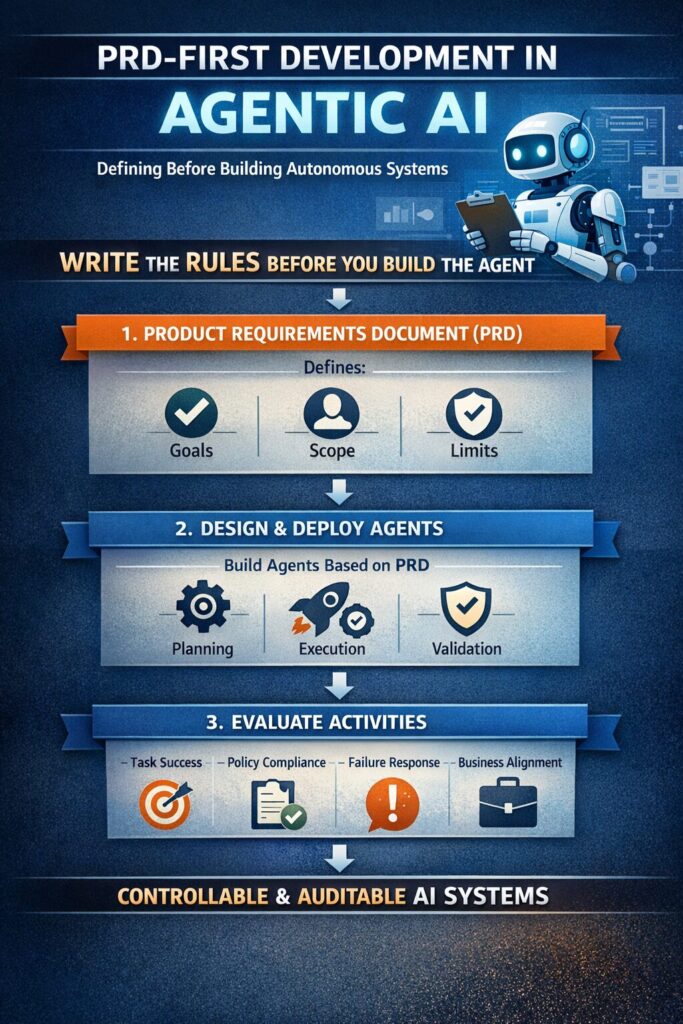
As AI systems evolve from simple chat interfaces into autonomous agents that plan, decide, and act, one uncomfortable truth has become clear: building first and figuring out control later no longer works.
This is where PRD-First Development enters the picture—especially within agentic engineering practices.
Far from being a theoretical idea, PRD-First is a practical, production-ready approach increasingly adopted by serious AI teams who need reliability, safety, and predictable outcomes.
The Problem With “Build First” Agentic AI
Traditional development habits break down quickly with agentic systems.
An agent can:
- Decide its own next step
- Use tools independently
- Chain actions without supervision
Without strict boundaries, this often leads to:
- Unclear behavior
- Goal drift
- Overreach into unintended actions
- Systems that appear successful but violate business intent
Prompt tuning alone cannot solve these issues.
What’s missing is explicit intent, written down before the system exists.
What PRD-First Development Actually Means
PRD-First Development simply means this:
You define what the AI system is allowed to do, why it exists, and how success is measured before you design or deploy any agents.
The Product Requirements Document becomes the control layer for the entire system.
In agentic engineering, the PRD is not a formality—it is the rulebook the agents must obey.
Why This Matters Specifically for Agentic Systems
Agentic AI is fundamentally different from traditional software:
| Traditional Software | Agentic AI |
|---|---|
| Executes instructions | Makes decisions |
| Deterministic | Probabilistic |
| Predictable flows | Dynamic reasoning |
| Limited autonomy | Expanding autonomy |
Because agents can act independently, undefined requirements translate directly into undefined behavior.
PRD-First development addresses this by turning vague ideas into enforceable constraints.
What a PRD Controls in Agentic Engineering
A well-written PRD answers five critical questions:
1. What is the agent’s responsibility?
Clear definition of its role and purpose.
2. What actions are explicitly forbidden?
Just as important as allowed behavior.
3. What inputs can the agent trust?
Data sources, freshness, and reliability.
4. When must the agent stop and escalate?
Confidence thresholds and human-in-the-loop triggers.
5. How is success evaluated?
Acceptance criteria tied to business outcomes, not model confidence.
Agents are then designed to comply with these constraints, not improvise around them.
Is This a Practical Approach or Just Theory?
It is practical—and already in use.
PRD-First development is commonly adopted by:
- Enterprise AI teams
- Agentic workflow platforms
- High-risk or regulated industries
- Product-led AI organizations
These teams cannot afford unpredictable autonomy.
Smaller teams and solo developers may skip it during experimentation, but once an agent touches real users, real data, or real systems, PRD-First quickly becomes unavoidable.
How PRD-First Changes the Development Flow
Instead of:
- Build an agent
- Add tools
- Fix behavior later
The flow becomes:
- Write the PRD
- Define agent boundaries
- Assign tools deliberately
- Validate against acceptance criteria
This shift dramatically reduces rework, hidden failures, and operational risk.
Why Adoption Is Increasing
As agentic systems become more capable, they also become more dangerous when poorly constrained.
PRD-First development offers:
- Predictable behavior
- Easier debugging
- Clear accountability
- Safer autonomy
- Stronger alignment with business goals
In practice, teams discover that writing the PRD early saves time, not the opposite.
The Bottom Line
PRD-First Development in agentic engineering is not a buzzword or academic exercise.
It is:
- A repeatable technique
- A professional standard for autonomous systems
- A necessary discipline as AI moves from assistant to actor
As agentic AI becomes more common, the question is no longer whether to adopt PRD-First development—but how long teams can afford not to.
Human Edge in the AI Age: Eight Timeless Mantras for Success | By the Bestselling Author of Winning in the Digital Age and Mastering the Data Paradox