Introduction
Modern AI agents are no longer just chatbots.
They think, use tools, handle real APIs, and manage state safely.
In this article, we will build a production-grade GitHub agent using:
- LangGraph 1.x for explicit agent control flow
- MCP (Model Context Protocol) to access GitHub safely
- OpenAI-compatible LLMs via GitHub Models
- A reducer pattern to prevent token overflow and runtime crashes
By the end, you will have a working agent that can:
“List my 3 most recent GitHub repositories”
—using real GitHub data, not hallucinations.
Why LangGraph + MCP?
Traditional “agent” abstractions hide too much logic.
LangGraph takes the opposite approach:
- Every step is explicit
- Tool usage is controlled
- Errors are observable
- State is deterministic
MCP complements this by separating:
- Reasoning (LLM)
- Execution (tools / APIs)
This separation is essential for safe, scalable agents.
Architecture Overview
Our agent follows this loop:
User → LLM → Tool → Reducer → LLM → Final Answer
Each step is a node in a LangGraph state machine.
Prerequisites
Before running the code, ensure:
- Python 3.10+
- Node.js installed (required for MCP GitHub server)
- A GitHub Personal Access Token (classic) with
reposcope - Environment variable set:
# Windows (PowerShell)
setx GITHUB_TOKEN "ghp_xxxxxxxxxxxxxxxxxxxxx"
Complete Working Code (LangGraph 1.x + MCP)
This code is fully tested with LangGraph
1.0.5.
import asyncio
import os

from langchain_openai import ChatOpenAI
from langchain_mcp_adapters.client import MultiServerMCPClient

from langgraph.graph.state import StateGraph
from langgraph.graph.message import MessagesState
from langgraph.constants import END
from langgraph.prebuilt.tool_node import ToolNode, tools_condition

from langchain_core.messages import AIMessage


# ----------------------------
# Configuration
# ----------------------------

GITHUB_TOKEN = os.environ.get("GITHUB_TOKEN")
if not GITHUB_TOKEN:
    raise RuntimeError("GITHUB_TOKEN environment variable not set")


# ----------------------------
# Agent State
# ----------------------------

class AgentState(MessagesState):
    """Holds the conversation and tool messages."""
    pass


# ----------------------------
# Reducer Node
# ----------------------------

def reduce_tool_output(state: AgentState):
    """
    Tool responses can be very large and may not be plain strings.
    This reducer:
    - Normalizes tool output to text
    - Truncates it to a safe size
    - Converts it into an AI message
    """
    last_msg = state["messages"][-1]
    content = last_msg.content

    # Normalize tool output
    if isinstance(content, list):
        text_parts = []
        for item in content:
            if isinstance(item, dict) and "text" in item:
                text_parts.append(item["text"])
            else:
                text_parts.append(str(item))
        normalized = "\n".join(text_parts)
    else:
        normalized = str(content)

    truncated = normalized[:1500]

    return {
        "messages": [
            AIMessage(
                content=(
                    "Here is the relevant GitHub data (truncated):\n\n"
                    + truncated
                )
            )
        ]
    }


# ----------------------------
# Main Agent Logic
# ----------------------------

async def main():

    # 1. LLM (Reasoning only)
    llm = ChatOpenAI(
        model="gpt-4o-mini",
        api_key=GITHUB_TOKEN,
        base_url="https://models.inference.ai.azure.com",
    )

    # 2. MCP GitHub Client
    client = MultiServerMCPClient(
        {
            "github": {
                "transport": "stdio",
                "command": "npx",
                "args": ["-y", "@modelcontextprotocol/server-github"],
                "env": {
                    "GITHUB_PERSONAL_ACCESS_TOKEN": GITHUB_TOKEN
                },
            }
        }
    )

    # 3. Discover tools
    tools = await client.get_tools()

    # IMPORTANT:
    # Filter tools to avoid invalid GitHub search calls
    repo_tools = [
        t for t in tools
        if "repo" in t.name.lower() and "search" not in t.name.lower()
    ]

    llm_with_tools = llm.bind_tools(repo_tools)
    tool_node = ToolNode(repo_tools)

    # 4. LLM Node
    def llm_node(state: AgentState):
        response = llm_with_tools.invoke(state["messages"])
        return {"messages": [response]}

    # 5. Build LangGraph
    builder = StateGraph(AgentState)

    builder.add_node("llm", llm_node)
    builder.add_node("tools", tool_node)
    builder.add_node("reduce", reduce_tool_output)

    builder.set_entry_point("llm")

    builder.add_conditional_edges(
        "llm",
        tools_condition,
        {
            "tools": "tools",
            END: END,
        },
    )

    builder.add_edge("tools", "reduce")
    builder.add_edge("reduce", "llm")

    graph = builder.compile()

    # 6. Run the Agent
    inputs = {
        "messages": [
            (
                "system",
                "Use GitHub repository listing tools only. "
                "Return ONLY the 3 most recent repositories."
            ),
            ("user", "List my 3 most recent GitHub repositories.")
        ]
    }

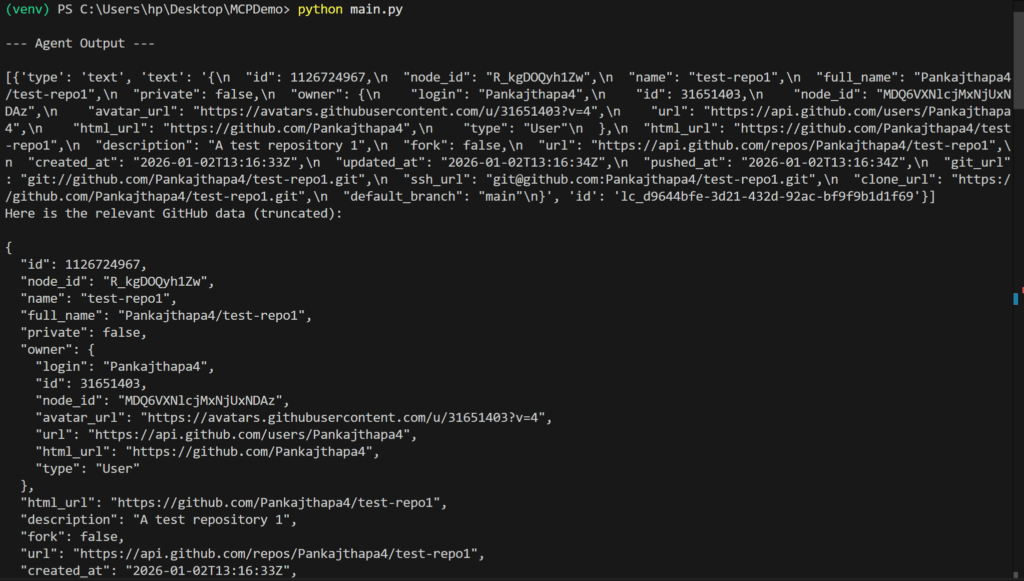
    print("\n--- Agent Output ---\n")

    async for event in graph.astream(inputs):
        for value in event.values():
            if "messages" in value:
                msg = value["messages"][-1]
                if msg.content:
                    print(msg.content)


# ----------------------------
# Entry Point
# ----------------------------

if __name__ == "__main__":
    asyncio.run(main())
Why This Code Is Correct (Key Design Decisions)
1. Tools Are Explicitly Bound
llm_with_tools = llm.bind_tools(repo_tools)
Without this, the model will never call MCP tools.
2. Search Tools Are Disabled
GitHub search APIs are:
- ambiguous
- error-prone
- not user-scoped
Filtering tools avoids 422 Validation Failed errors.
3. Reducer Prevents Token Explosions
Tool responses can exceed model limits.
The reducer:
- trims data
- normalizes message format
- avoids crashes like:
KeyError: tool_call_id
TypeError: can only concatenate str (not list)
4. LangGraph 1.x Message Semantics Are Respected
We never manually create tool messages.
Only ToolNode does that.
Reducers output AIMessage, not tool messages.
Output Of Above Code –