
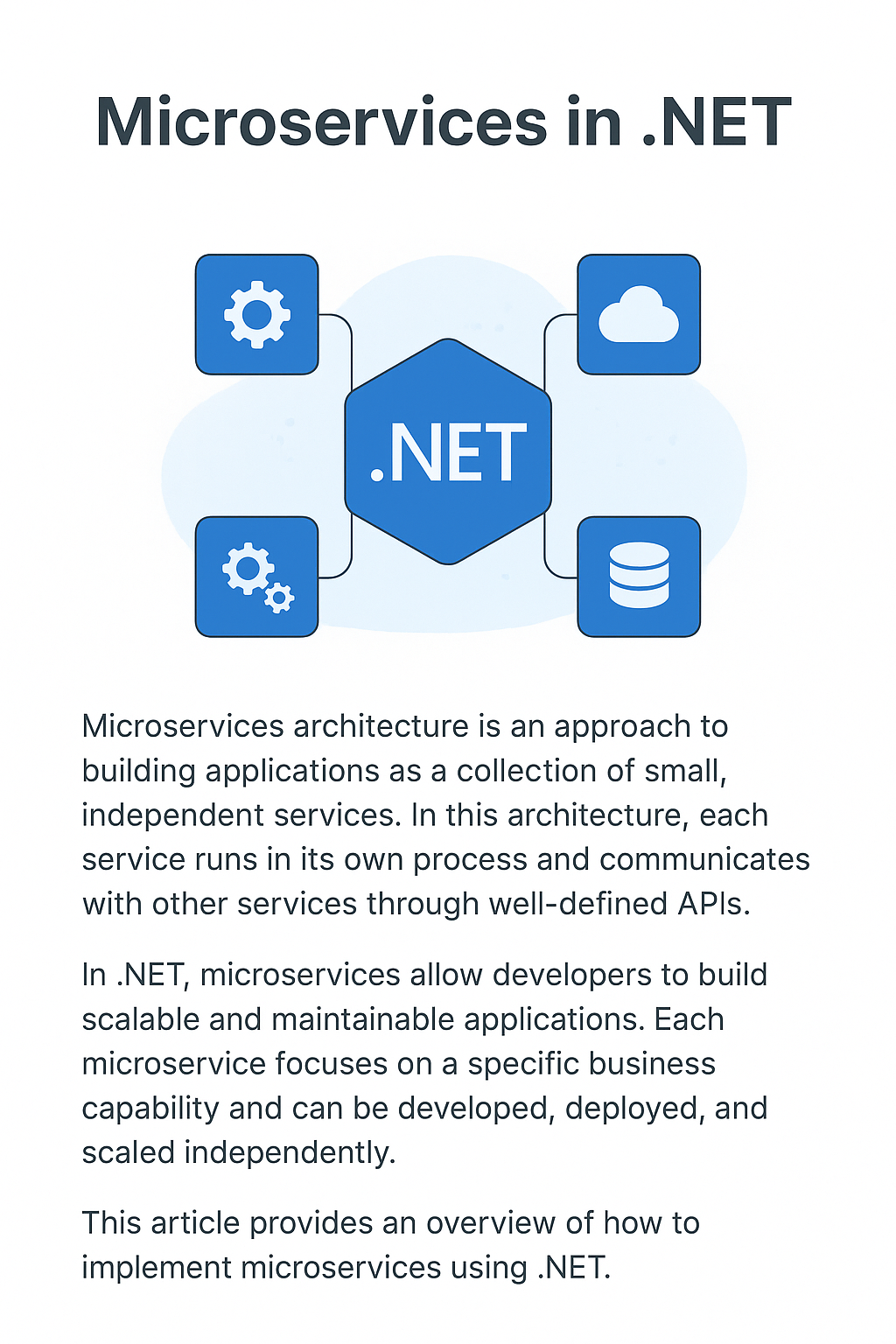
Microservices architecture is a powerful approach for developing scalable, flexible, and cloud-ready applications. Unlike traditional monolithic systems, where all components are tightly coupled, microservices break applications into independent, loosely coupled services that communicate via lightweight protocols such as REST APIs or message queues. This separation enables organizations to achieve faster development cycles, improved scalability, and easier maintenance.
Why Choose Microservices in .NET?
With the evolution of .NET 6/7 and ASP.NET Core, Microsoft’s ecosystem has become a leading platform for building microservices-based applications. Its cross-platform support, high performance, and containerization compatibility make .NET an ideal choice for modern enterprises. Developers can build and run .NET microservices seamlessly across Windows, Linux, Docker, and Kubernetes environments.
Key Benefits of Microservices in .NET
- High Scalability – Scale individual services independently to optimize performance.
- Fault Isolation & Resilience – Prevent failures in one service from impacting the entire application.
- Technology Flexibility – Leverage different programming languages, databases, or frameworks per service.
- Faster Time-to-Market – Parallel development accelerates deployment and release cycles.
Essential .NET Tools for Microservices
- ASP.NET Core Web API – Build high-performance, lightweight REST APIs.
- gRPC for .NET – Enable fast, low-latency communication between services.
- Docker & Kubernetes – Simplify containerization and orchestration for cloud-native apps.
- Ocelot API Gateway – Manage routing, authentication, and cross-cutting concerns efficiently.
- Dapr (Distributed Application Runtime) – Add reusable microservice patterns like pub/sub and state management.
Best Practices for Microservices in .NET
- Design services around business capabilities and keep them small.
- Adopt asynchronous communication for improved scalability.
- Implement centralized logging, monitoring, and observability.
- Secure microservices with OAuth2, JWT, and API Gateway authentication.
- Automate deployments with CI/CD pipelines and DevOps practices.
Conclusion
Adopting microservices with .NET allows businesses to build cloud-native, scalable, and maintainable applications. By leveraging .NET’s strong tooling, containerization support, and seamless integration with Microsoft Azure and other cloud providers, organizations can accelerate digital transformation and deliver robust, future-ready solutions.