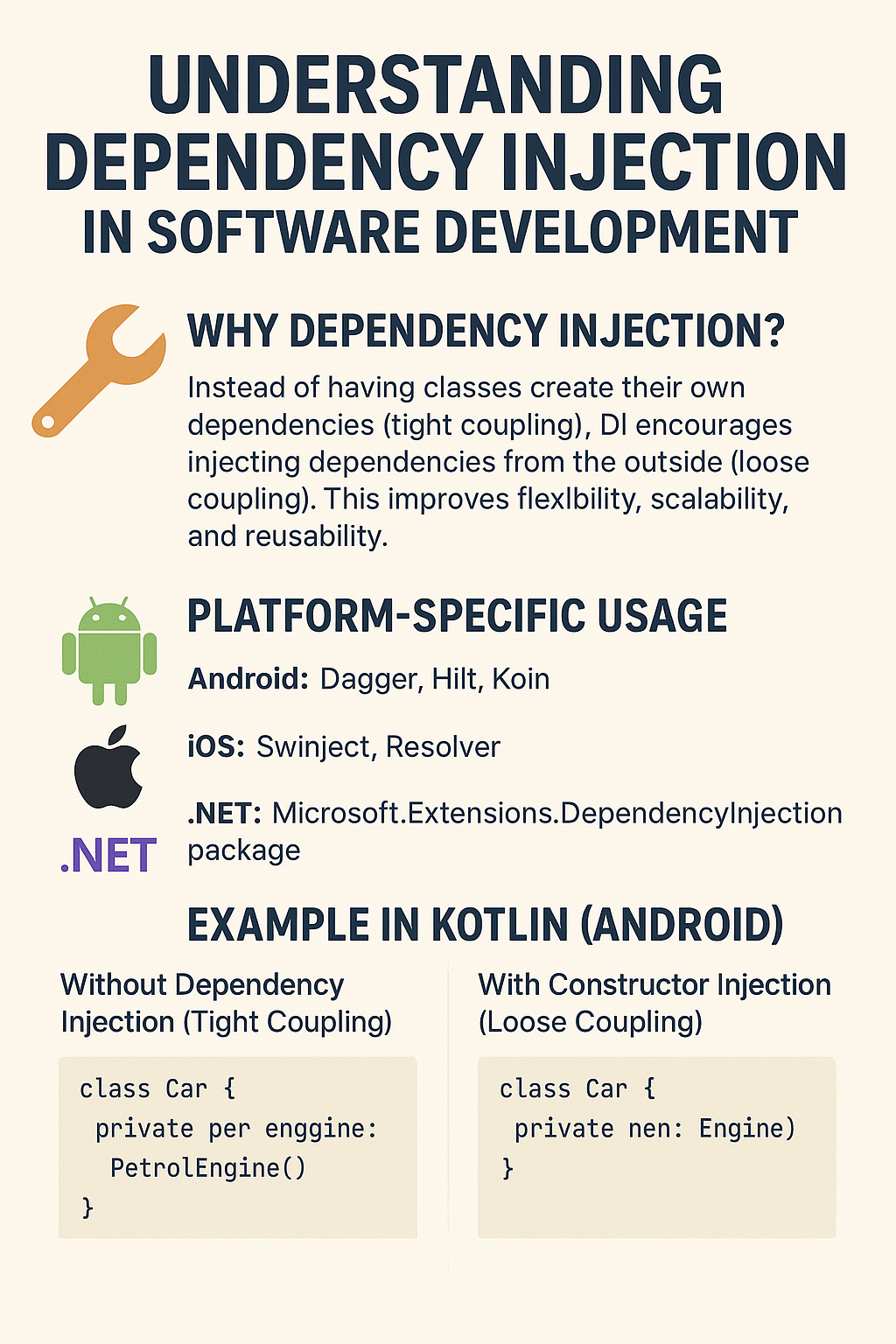
Understanding Dependency Injection in Software Development
Dependency Injection (DI) is a fundamental principle in modern software development. Whether you’re building mobile apps or web applications, DI plays a crucial role in writing clean, maintainable, and testable code.
🔧 Why Dependency Injection?
Instead of having classes create their own dependencies (tight coupling), DI encourages injecting dependencies from the outside (loose coupling). This improves flexibility, scalability, and reusability.
📱 Platform-Specific Usage
Android: Popular libraries like Dagger, Hilt, and Koin provide robust DI frameworks.
iOS: Frameworks such as Swinject and Resolver are commonly used.
.NET: Native support for DI is built into the framework via the built-in Microsoft.Extensions.DependencyInjection package.
💡 Example in Kotlin (Android)
Let’s take a simple example:
// Without Dependency Injection (Tight Coupling)
class Car {
private val engine = PetrolEngine()
}
In this case, Car is tightly coupled to PetrolEngine, making it hard to test or switch engines.
✅ With Constructor Injection (Loose Coupling)
class Car(private val engine: Engine)
Now, we can pass any type of engine:
Car(PetrolEngine())
Car(ElectricEngine())
Car(DieselEngine())
This makes the Car class more flexible, testable, and reusable. You can even mock the Engine for unit testing!
🧠 Takeaway: Dependency Injection is not just a pattern—it’s a practice that leads to better architecture and long-term maintainability. Start applying it, and your codebase will thank you.